Company

Founded on experience inside the institutions we serve

ThirdPartyIQ exists because the people who built it ran vendor risk programs inside community financial institutions, watched GRC tools fail to meet examiner expectations, and built a platform to close that gap.

Founder

Track record in GRC, built from the inside

Before ThirdPartyIQ, our founder built a GRC platform from the ground up inside the community financial institution market — growing revenue at a 40% 7-year compound annual rate and delivering an 8x valuation increase. That platform was built incrementally, in close contact with the vendor risk officers, compliance directors, and examiners who had to use and review the work product.

The lessons from that work — about what examiners actually look for, what documentation fails under examination, and where small teams lose time to process overhead — are in every ThirdPartyIQ product decision.

Track record

40%

7-year revenue CAGR

Prior GRC platform

Valuation increase

Over the same period

15+

Years in GRC and financial services

Community FI focus

What we learned

What running a vendor risk program inside a community FI actually teaches you

The hardest part of vendor risk management at a community bank or credit union isn't understanding the risk. It's producing documentation that satisfies an examiner's standards when you have one or two people managing 100+ vendor relationships — and the quarterly review cycle that made sense when you had 30 vendors hasn't scaled with the portfolio.

Most available tools were built for larger institutions and adapted for smaller ones — with all the friction that produces. Workflow steps assume staff that don't exist. Documentation templates assume time that isn't available. And none of it was built with the 2023–2024 interagency guidance updates in mind, which raised the ongoing monitoring bar substantially.

ThirdPartyIQ starts from those constraints. The platform assumes a small team, a large portfolio, tight examination timelines, and an examiner who is going to read the documentation. That's a different design target than most of what's available — and the difference shows in the output.

How we build

Four things that don't change

Examiners read this

Every feature is evaluated against a single question: if an examiner sees this output in a file review, does it satisfy guidance or create a finding? That test shapes what we build and what we don't.

Human accountability, always

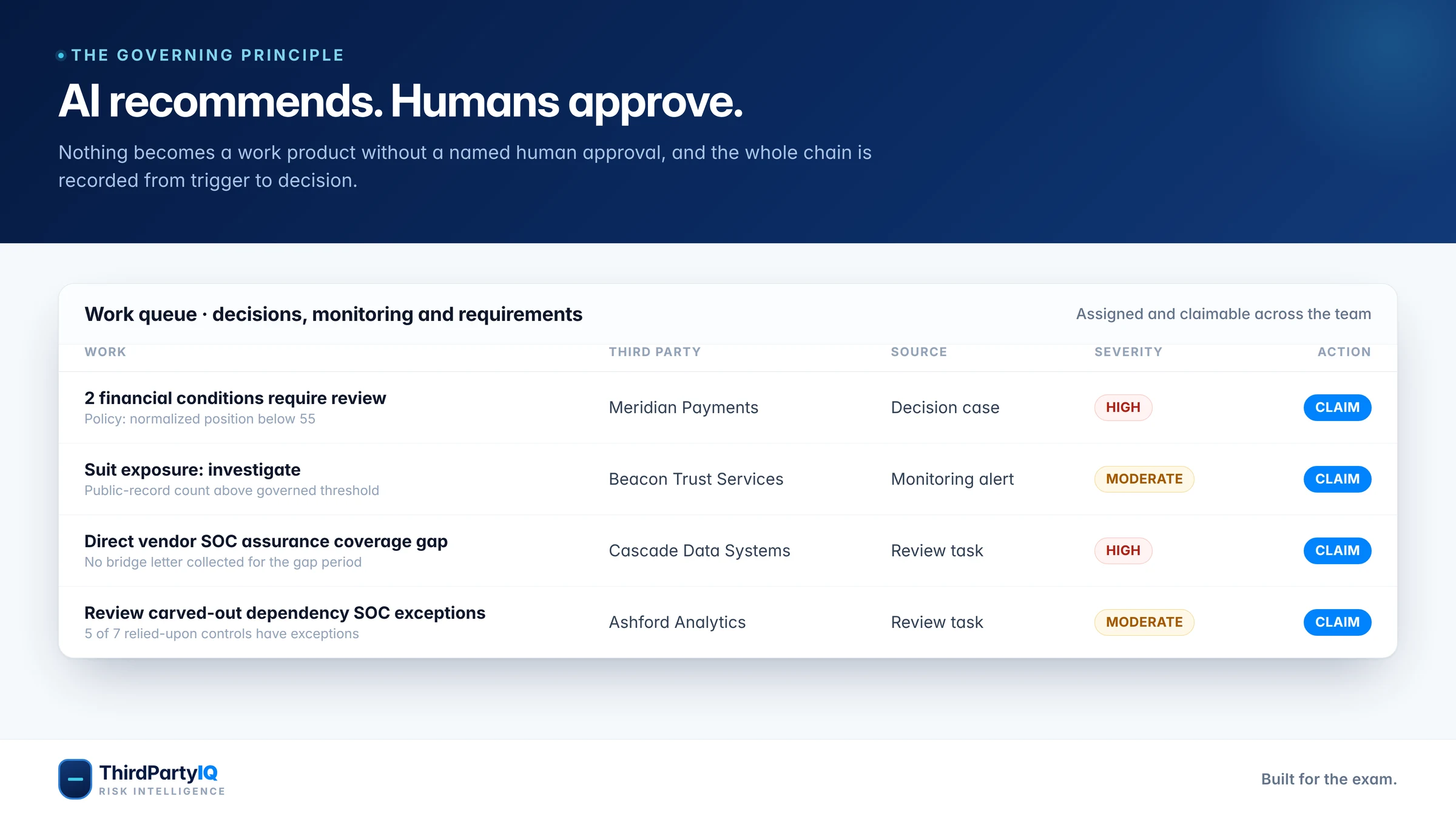
No automated risk ratings. No AI-generated conclusions without a reviewer sign-off. Every decision in the platform traces to a person — because that's what examination requires.

Practitioners over process

ThirdPartyIQ is built with direct input from vendor risk officers inside community banks and credit unions. The workflow reflects how the work gets done on the ground, not how a project plan says it should.

Incrementally, not big-bang

We ship capabilities when they're ready to pass examination — not when a roadmap says they're due. Each release is tested against real examiner feedback before it becomes the default workflow.

Right now

What we're working on

Expanding continuous monitoring signal coverage

Adding financial health indicators, news monitoring, and regulatory filing alerts to surface material vendor changes faster and with more context.

Building the shared vendor profile network

ThirdPartyIQ is building a shared vendor profile network to reduce duplicated due diligence work across institutions that share common vendors.

FFIEC IT handbook alignment

Adding documentation templates aligned to the FFIEC IT Examination Handbook for technology vendor relationships — covering service provider management and business continuity requirements.

Talk to the people building it

We take calls from vendor risk officers and compliance directors at community banks and credit unions. Tell us where your program stands — we'll tell you where ThirdPartyIQ fits.

Get in touch